
by Krysis
Greetings, all! Before jumping into the subject of this article, I would first like to take a minute to thank BananaCrapshoot for the opportunity to be a contributing writer for the SAGA website. I have known Banana since the days of Star Wars: Destiny, and somehow, despite all the effort he put into Discard to Reroll at that time, he has managed to put even more time and effort into Space Arena Ground Arena. It is an honor to be part of what we hope will be a growing catalog of content creation coming out of SAGA moving forward!
So, with that said, this article is meant to focus on the set 1 impact, and predictive impact moving forward into set 2, of the Spark of Rebellion Legendary cards. And of course, I will be providing an ever-popular tier ranking of these 16 cards! I will even provide this tier ranking immediately below, but nonetheless I encourage you to read on for in depth review and set 2 predictions for each card. Should you enjoy this article, be sure to be on the lookout for part 2 of my legendary card review next week, which will focus on predictions (and yes, predictive tier ranking!) for each Shadows of the Galaxy legendary. So, without further ado…
S: Darth Vader (Commanding the First Legion), Boba Fett (Disintegrator), Cunning, Vigilance
A: Luke Skywalker (Jedi Knight), Millenium Falcon (Piece of Junk), Avenger (Hunting Star Destroyer)
B: Superlaser Blast, Home One (Alliance Flagship), Change of Heart
C: Devastator (Inescapable), Command, Force Lightning, Mace Windu (Party Crasher)
D: Black One (Scourge of Starkiller Base), Aggression
Now, if you have not laughed at me and closed the webpage, I will use the remainder of this article to further discuss each individual card, why it is ranked where it is, and where I see it fitting in the meta moving into Shadows of the Galaxy.
S Tier: Cards within this tier are not only the best of the best legendary cards in the set, but have proven to be amongst the absolute best cards in the entire set 1 meta. Cards within this tier shape the meta, if not warp it at times.
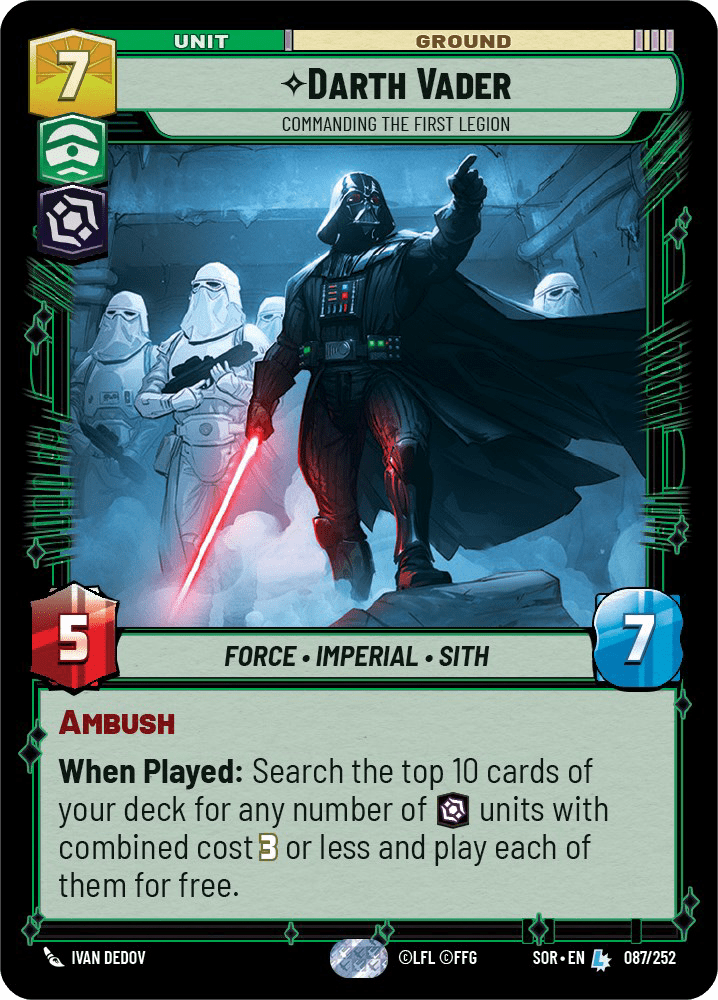
Darth Vader (Commanding the First Legion):
First on our list of S-tier cards is the big Sith Lord himself, Darth Vader. Vader was identified immediately as likely to be one of the most powerful units in the Spark of Rebellion set, and he did not disappoint. At 7-cost, Vader boasts a 5/7 stat line with Ambush, and even brings another (cost total 3 or less, villainy) unit(s) along with him. Vader was a quintessential component of some of the absolute best decks in the set 1 meta, such as Command Boba Fett and Command Krennic. Vader offers everything you could possibly want from a 7-cost bomb unit. There is no reason to believe he is going anywhere in the set 2 meta, although he will see some competition in the 7-cost command villain slot via the likes of Maul, who may steal a spot in many Underworld tribal decks.
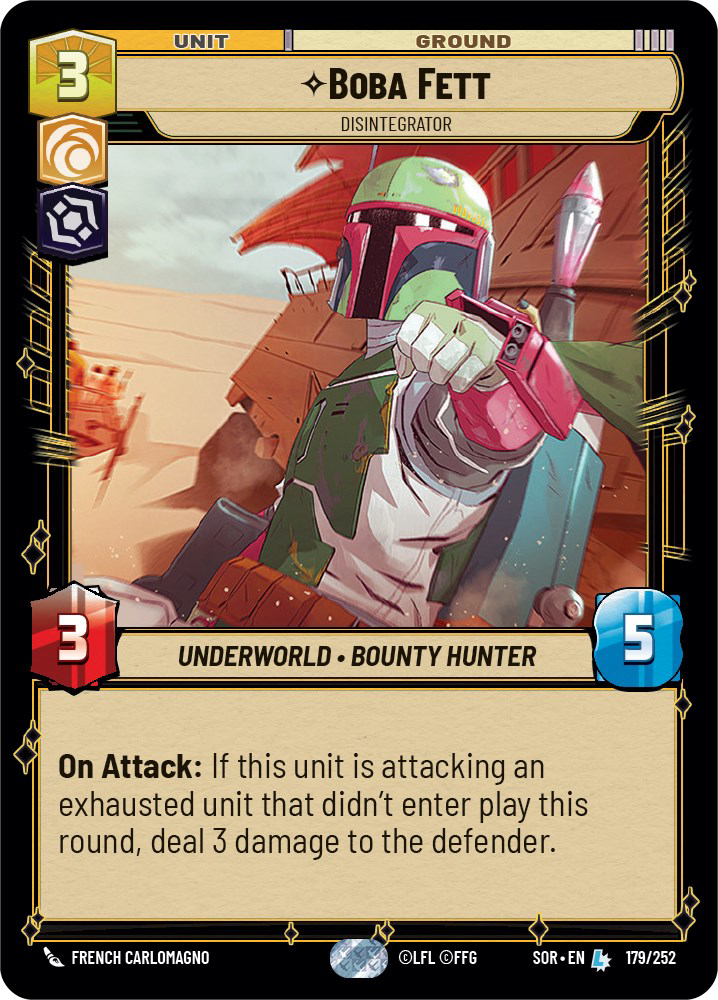
Boba Fett (Disintegrator):
Next on our list of S-tier cards, Boba Fett. And despite what Darth Vader may say, there will indeed be disintegrations. Just like Darth Vader above, Boba Fett was one of the key pieces of some of the best decks in the set 1 meta, such as Cunning Boba Fett and Command Boba Fett. In reality, Boba was an auto-include in nearly every deck running Cunning Villainy, which is a clear sign of his impact on the game. Boba’s ability to deal 3 On Attack damage to any exhausted unit (that did not enter play that turn) often allows him to simply eat opposing units, free of charge! Beyond that, Boba boasts a set 1 unheard of stat line of 3/5 at just 3-cost, allowing him to survive all but the biggest hitters. Boba is only going to get better moving into the set 2 meta given the plentiful influx of underworld and bounty hunter tribal synergies (not to mention he gets his own armor!). Boba will continue to appear in nearly every Cunning Villainy build moving forward.

Cunning:
Next up, the first of our Aspect cards, Cunning. Cunningmade a somewhat slow entry into the forefront of the set 1 meta. However, once people caught on, it began to show up in many Cunning decks. As a testament to its power and impact, it even became commonplace in single aspect Cunning decks that mustpay 6 resources to play it. All its 4 options (return a non-leader unit with 4 or less power to its owner’s hand, give a unit +4/+0 for this phase, exhaust up to 2 units, an opponent discards a random card from their hand) have highly effective use cases. Bouncing a unit and exhausting 2 can setup blowout rounds, especially with leaders such as Boba Fett, and the +4 wins games. Discarding a card can be back breaking to decks that tend to play on small hands, such as Han Solo. Set 2 is bringing us a hearty influx of high impact yellow villainy units, such as 4-Lom and Zuckuss, meaning Cunning will remain in the spotlight of many Cunning decks in the set 2 meta.

Vigilance:
And now the last of our S-tier cards, and our second Aspect card, Vigilance. Vigilance was very specifically the last card I placed into S-tier, and in my rough draft rankings had it in A at one point. Vigilance does not always create the same blowout opportunities that Cunning may, but it makes the cut into my S-tier for being a primary enabler of an entire set 1 deck archetype: hard control/mill. Decks such as mono Vigilance Iden or, to a somewhat lesser extent, Vigilance Darth Vader, may not have been able to exist without this card. Even as a Command Krennic player myself, I packed 2 of these in my mainboard. The ability to heal 5 damage from base and defeat a unit with 3 or less remaining HP was paramount in consistently defeating aggro decks, and the ability to discard 6 cards from top of deck is what powered mill-oriented control decks. Vigilance is likely to remain a staple in hard control decks, and to date is the primary engine for any deck trying to mill, and therefore will not be going anywhere in the set 2 meta. Some single aspect Vigilance decks, however, could look to try cheaper set 2 heal engines, such as The Client or Top Target, which could bump Vigilance down into A tier.
A Tier: Cards within this tier are highly impactful and/or fit into many deck archetypes. They may not dictate or warp the meta as a whole, but are often found in some of the best decks in the format.
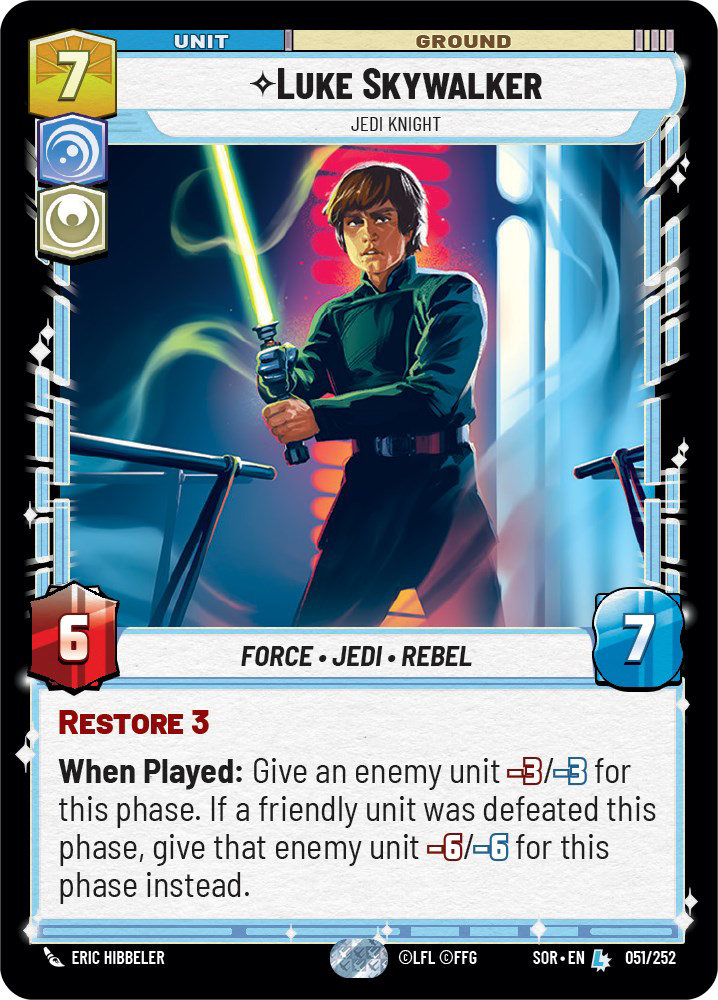
Luke Skywalker (Jedi Knight):
First up amongst our A-tier legendaries, the blue milk chugging hero, Luke Skywalker. Luke, in a vacuum, has as big an impact as Darth Vader or Boba Fett do in S-tier. Luke boasts a fantastic 6/7 stat line at 7-cost, along with a ridiculous Restore3 ability. And like with any great high cost unit, Luke will erase an opposing unit upon entering the arena. When played, Luke gives an opposing unit -3/-3, or -6/-6 instead if one of your units have been defeated this round, making Luke a virtual guarantee to warp the board state. The only thing keeping Luke in my A-tier is the lack of a tier 1 deck to call home. Luke’s best set 1 fit was in Command Luke Skywalker, a very strong but overall tier 2 deck. Should a Vigilance heroism deck emerge into tier 1 in the set 2 meta, Luke will rapidly become an S-tier legendary card.

Millenium Falcon (Piece of Junk):
Next up in our A-tier, the Millenium Falcon. The Falcon boasts an impressive 3/4 stat line at 3-cost. The 4 HP, in particular, proves to be rare on a 3-cost space unit. The stat line in and of itself does not make the Falcon an A-tier card, but the fact that it enters play ready pushes it into A-tier. The Falcon found itself featured in some of the best decks in the set 1 meta, including Cunning Sabine Wren and Command Han Solo. The Falcon is particularly excellent in Han Solo decks, so brownie points to the design team! This is due to the 1 downside of the Falcon, having to exhaust a resource at the start of each round to keep it in play, being flatly negated by Han Solo’s ability to cheat in a resource and then defeat the exhausted one to open the next round. The Falcon will continue to appear in many Cunning Heroism decks moving forward, though in the future may fall off some if additional 3-cost 3/4 space units emerge.
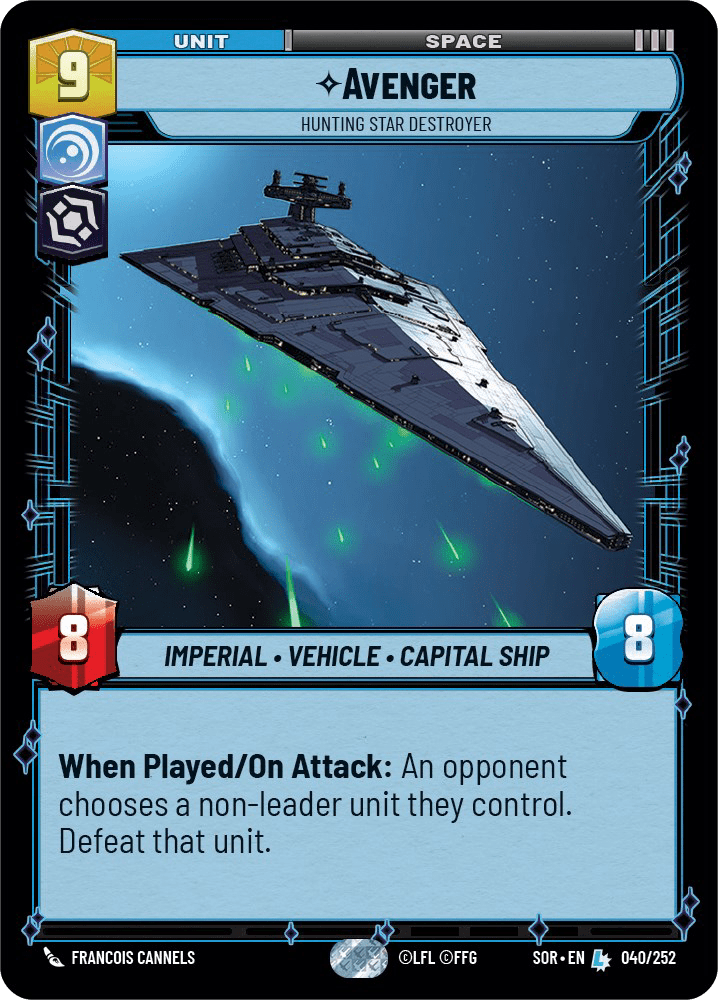
Avenger (Hunting Star Destroyer):
The last of our A-tier legendaries, Avenger. Avenger is a game winning unit, and as such checks in with a 9 resource cost. However, Avenger enters play with an enormous 8/8 stat line and a when played ability that forces the opponent to choose and defeat one of their units. As if that is not good enough, Avenger recurs this ability every round On Attack as well. As a result, Avenger is a stalwart addition to all hard control and ramp/soft control decks, as it can single handedly win the game. Avenger is likely to remain a mainstay in these hard control and soft/ramp control decks in the set 2 meta, but will receive some competition from cards such as Krayt Dragon and Snoke in certain deck builds. It will also become slightly less oppressive as more effective removal options for massive units become available, such as Rival’s Fall. Nonetheless, Avenger will continue to see heavy play in the set 2 meta.
B Tier: Cards in this tier have exceptionally strong use cases and abilities, but generally do not have as significant an impact on the meta as S-tier or A-tier cards. They will see heavy play, though as the meta shifts may become more common in sideboards than mainboards.
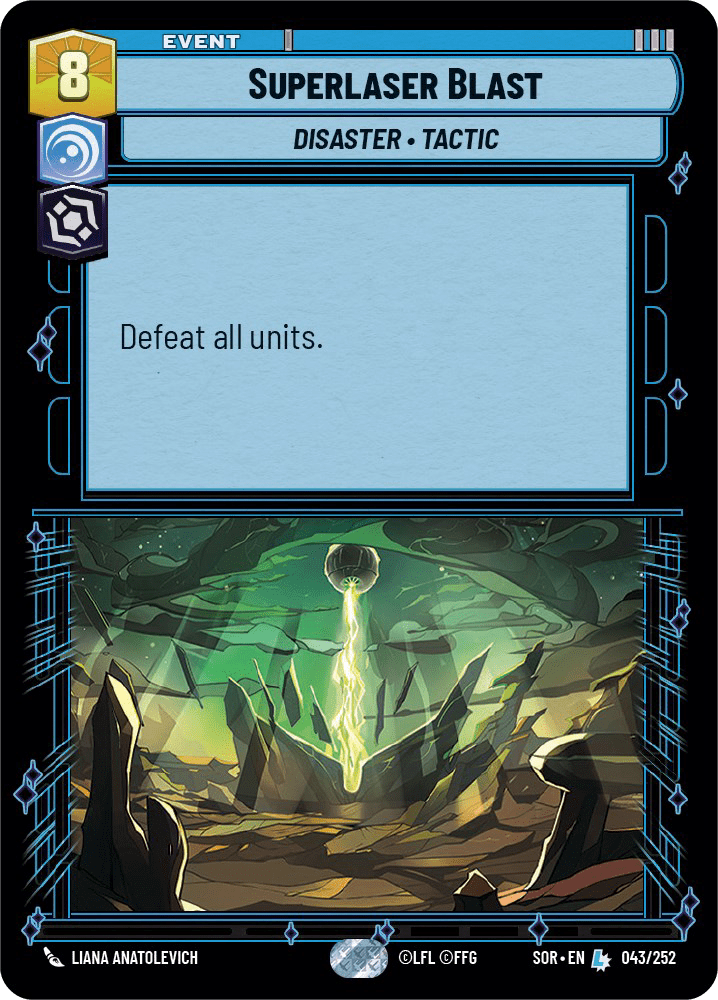
Superlaser Blast:
The first of our B-tier legendaries, Superlaser Blast. Superlaser blast was not initially highly regarded, certainly not in my own play group, due primarily to its prohibitive cost as an 8-cost event. However, the ability to defeat all units on the board has proven to be a staple in most TCGs, and the same is true here. Superlaser blast by itself can feel like a mediocre card, as you spend 8 resources to defeat all units, just to watch the opponent use their resources to put more units down on the board. However, the card quickly became a staple in hard control decks, especially in Vigilance Darth Vader, which became its true enabler. The ability to control the board state up to a Superlaser blast and then immediately deploy the Darth Vader leader, followed by playing big units such as Palpatineand Avenger was the catalyst to cause Superlaser blast to explode in usage and popularity. The card will remain a staple of hard control decks moving forward, though is unlikely to see much mainboard play outside of that deck archetype.
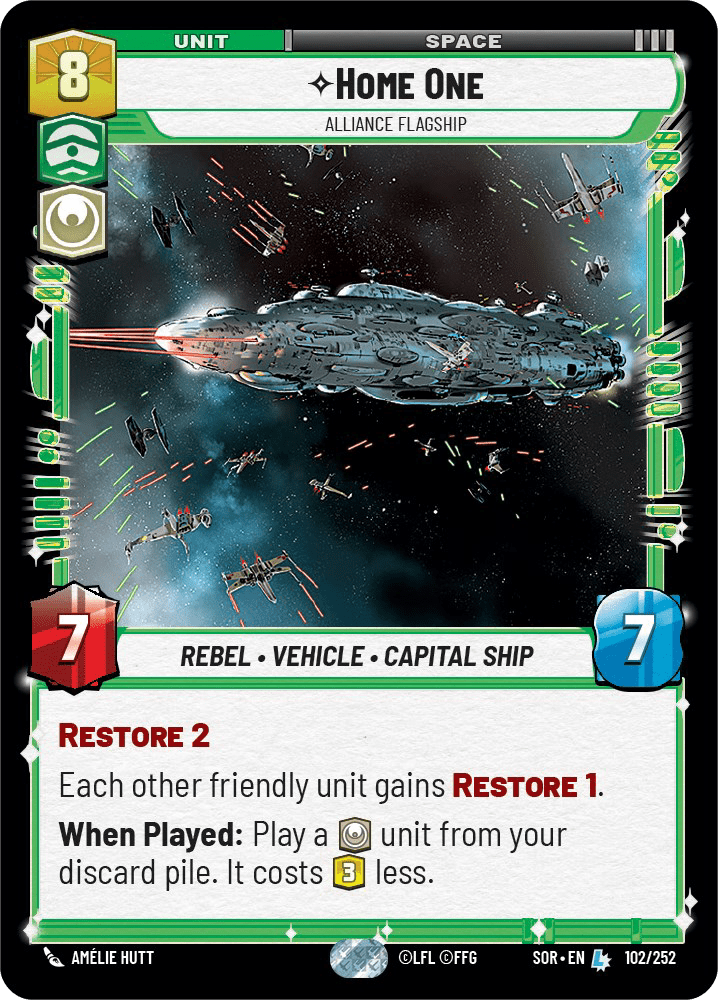
Home One (Alliance Flagship):
Home One checks in as the biggest and baddest space unit currently available in the heroism lineup. Home One boasts a solid stat line of 7/7 at 8-cost, and comes packing a Restore2, as well as giving each other friendly unit Restore1 to boot. Similar to Darth Vader in S-tier, Home One fetches another unit along with it. In this case, it allows you to play a heroism unit from your discard pile, reducing its cost by 3 resources. Home One has everything to make it an extremely high impact unit, but suffers from hero’s relative inability to ramp up the resource curve and control the board state in the same way that villainy can. This makes Home One a bit of a slow unit, but it does find a home in decks such as Command Han Solo and Command Luke Skywalker. Moving forward, Home One has the potential to move up these rankings as more ramp options become available to heroism decks, such as Spark of Hope in set 2.
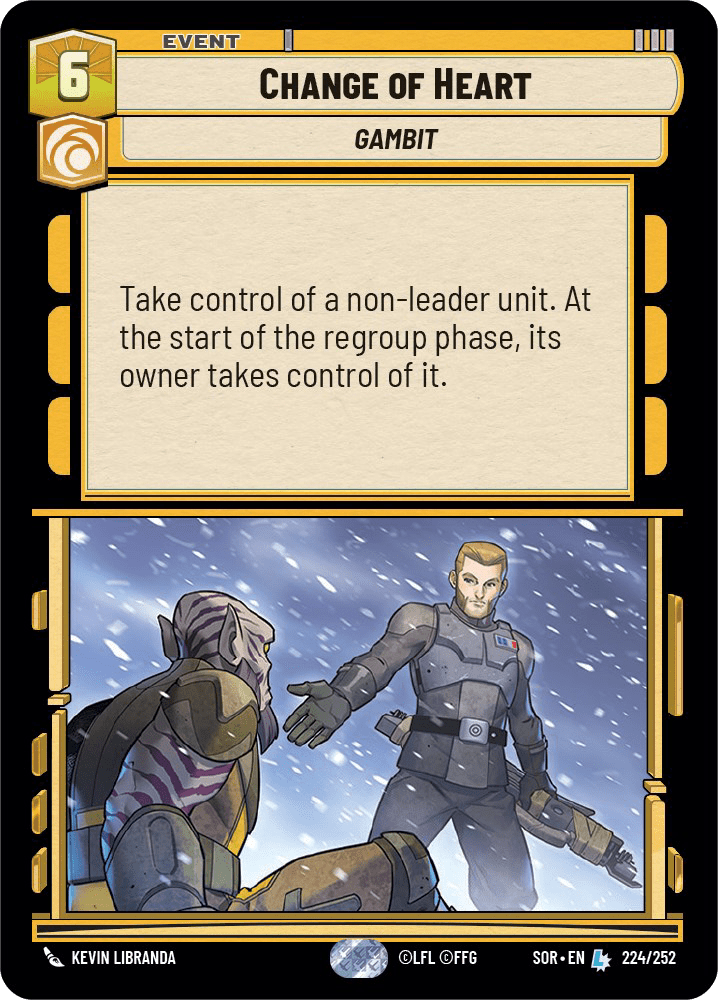
Change of Heart:
Last on our list of B-tier legendaries is Change of Heart. Change of Heart is another stylistic staple of most TCGs (and hell, in some cases… *cough cough* Yugioh *cough cough*… it’s just called, you guessed it, Change of Heart). Change of Heart allows you to take control of a non-leader opposing unit for the phase, returning control to its owner during the regroup phase. In the set 1 meta, Change of Heart saw some mainboard usage in some tier 2 decks and even a couple Cunning Sabine decks, but mostly was a sideboard staple for many Cunning aggro or mid-range decks, such as mono Cunning Boba Fett and Command Boba Fett, or Command Han Solo. If Change of Heart were to move up these tier rankings, it would likely be on the back of Emperor Palpatine, whose On Attack ability allows you to defeat the stolen unit instead of returning it. Nonetheless, it should remain a card that is at least seeing sideboards regularly as tech against ramp/control decks.
C Tier: Cards in this tier remain powerful, but typically have something prohibitive or limiting about them that make them difficult to use effectively on a consistent game in, game out basis.
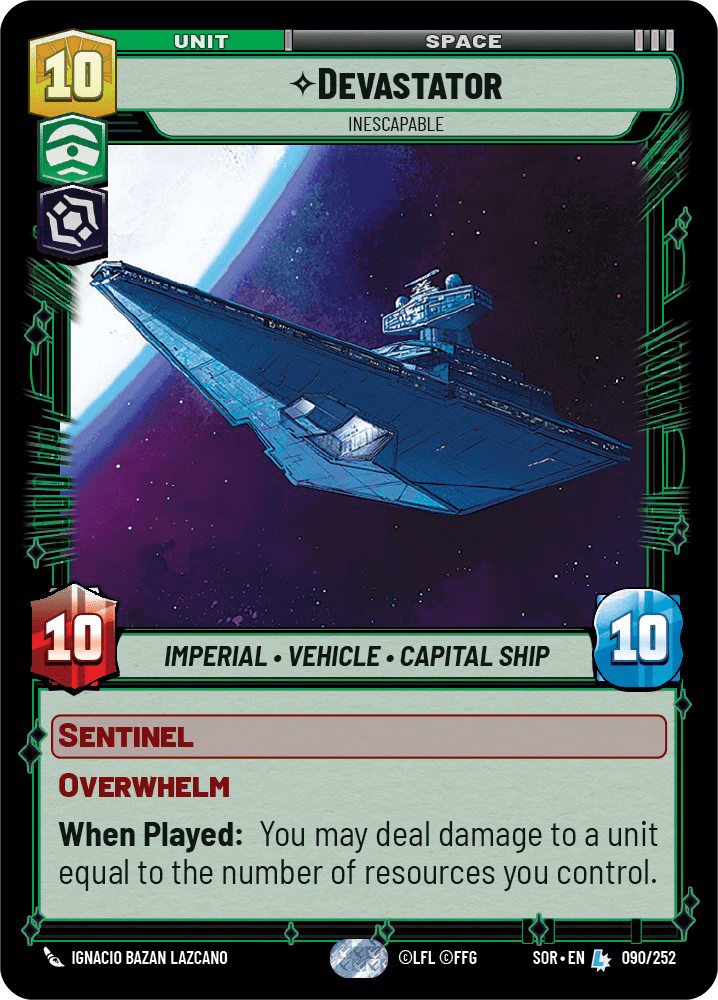
Devastator (Inescapable):
First up in our C-tier, another massive capital ship at the disposal of villainy decks. Devastator checks in with an enormous 10 resource cost, but boasting an equally enormous stat line of 10/10. Devastator also boasts keywords for Sentinel and Overwhelm, making it the undisputed king of the space arena once it hits the board. Furthermore, Devastator has a When Played ability allowing you to deal damage to a unit equal to the number of resources you control. In most cases, this will be 10+, allowing you to instantly kill most any unit currently in existence. As powerful as Devastator is, it checks into my C-tier on account of being so cost prohibitive at 10 resources and having an ability that, in my opinion, is outclassed by the 9 cost Avenger found in my A-tier. Devastator was a sideboard staple in my Command Krennic build, and I believe it will continue to see plenty of sideboards in ramp/control decks and even some mainboard play if the meta is a slower one. As more ramp options become available, Devastator could become less cost prohibitive and move up these rankings.
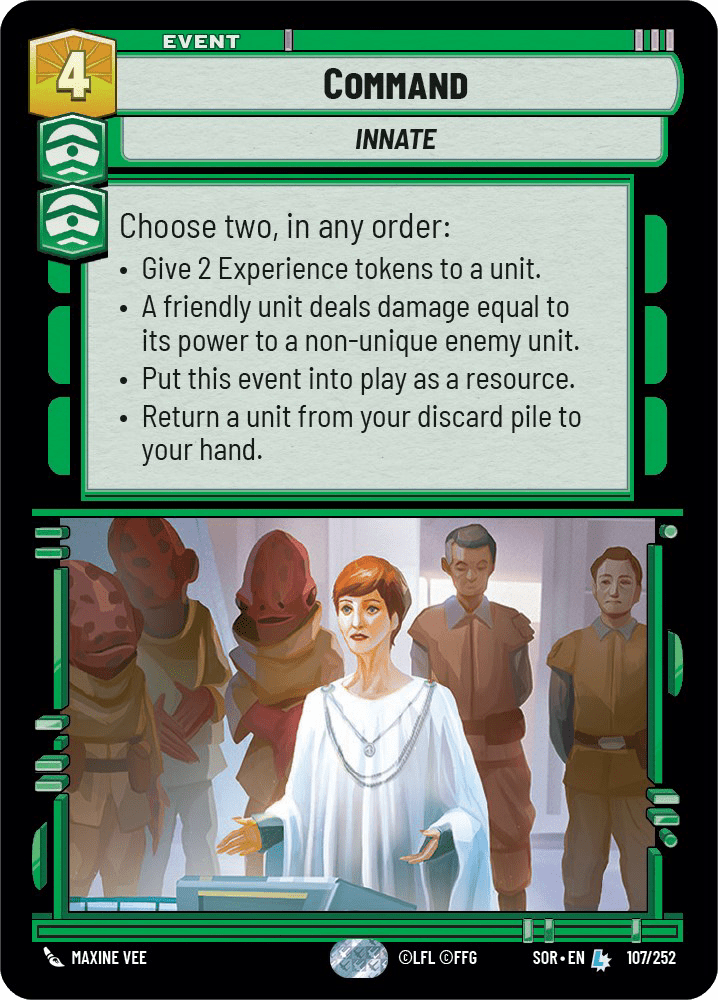
Command:
Next in our C-tier, and the first Aspect card in a hot minute, Command. Let’s call it what it is, Command’s 4 choices (give a unit 2 xp tokens, a friendly unit deals damage equal to its power to a non-unique unit, put this event into play as a resource, and return a unit from your discard pile to your hand) are simply not as impactful to the game state as those offered by Cunning or Vigilance, at least not in the existing meta. Command mostly saw fringe use in decks such as mono Command Palpatine, but otherwise often stayed in the binder. Command could see a boost moving forward as more ramp cards become available, which could inevitably breed a hard ramp deck designed to get out massive bomb units as quickly as possible.
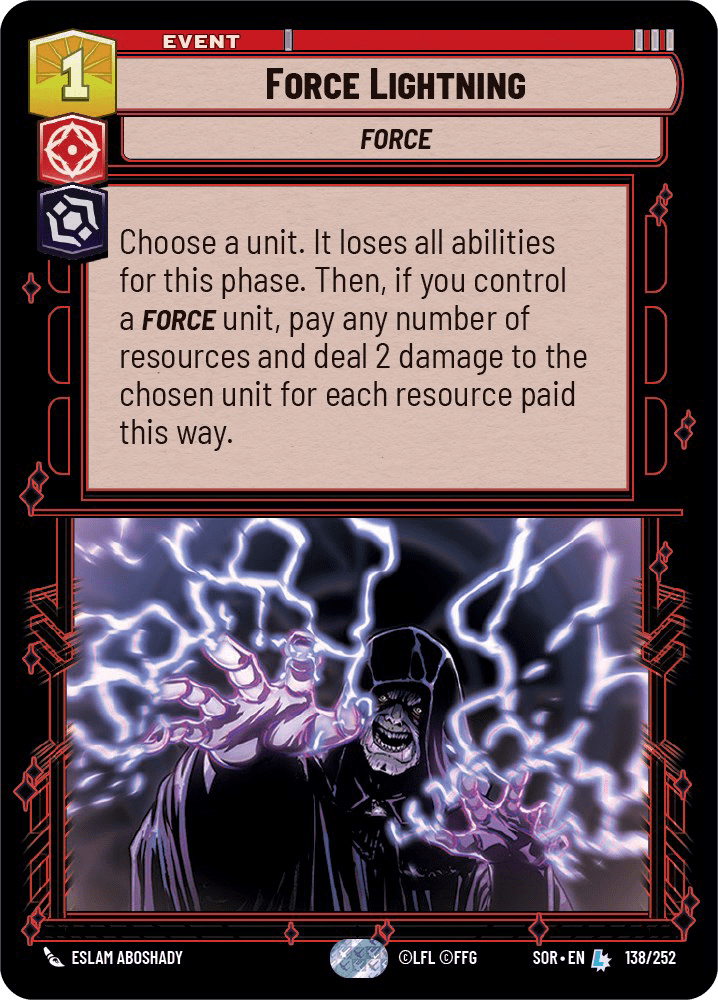
Force Lightning:
Next in C-tier, one of my personal favorite cards that sees almost no play at all, Force Lightning. In a vacuum, Force Lightning is a fantastic card. At just 1-cost, its base effect blanks the text on any unit. K2-SO? No thanks, to that 3 damage. Boba Fett leader? No thanks, to your resource efficiency. To top it off, if you control a force unit, you may pay any number of resources to deal 2 damage to the selected unit for each resource paid. Therein lies the problem, however. As it currently stands, the most played Force tribal units tend to be expensive in cost (e.g. Darth Vader, Palpatine, etc) and our cheapest Force Villainy leader is currently Grand Inquisitor, who does not deploy until 6 resources. Force Lightning has the potential to rapidly move up this list with cheaper Force units or, preferably, an early deploy Force leader. We nearly got this from set 2 in Kylo Ren leader, but it appears he will be a full tilt aggro leader that won’t make use of Force Lightning in most builds.
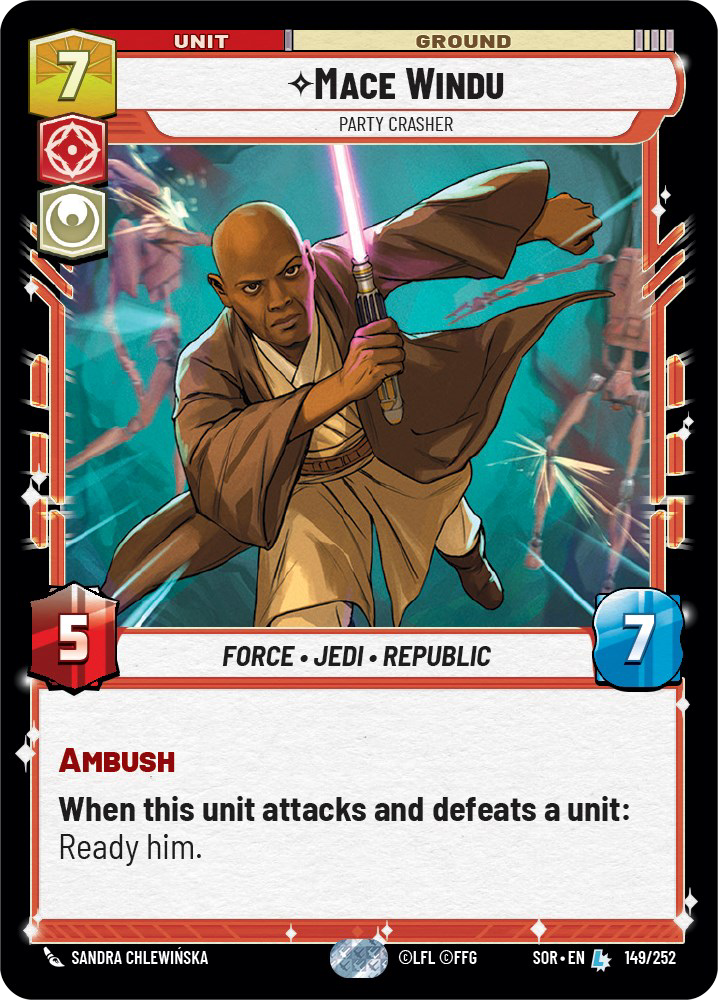
Mace Windu (Party Crasher):
Last in C-tier, Mace Windu. Store Showdown promos, anybody? Great, that allowed me to sell my regular ones to my LGS for store credit to the tune of… *checks notes*… $4/each. That tells you about what you need to know about our purple lightsaber wielding Party Crasher. To be fair, in a vacuum, Mace is a very strong unit. At 7-cost, he checks in with a strong 5/7 stat line, boasts ambush, and most importantly, he readies every time he defeats a unit. The potential exists here to wipe multiple enemy units and still punch the opposing base for 5. Unfortunately, Mace has absolutely no home right now in anything but low tier deck builds. Furthermore, Mace feels unlikely to move up these rankings anytime soon, given the uncontested best version of Aggression Heroism is via Sabine Wren aggro. Until a new leader, or at least a leader playing an Aggression base, offers something better than what Sabine does, Mace will not see any competitive usage. There is some potential hope coming in set 2 via the new Aggression Han Solo leader, but only time will tell.
D Tier: Cards in this tier are objectively weaker than other legendaries, and have fewer prospects or scenarios in which they could move up the ranking. They are not unplayable in the full card pool, but can be out classed by common/uncommon cards in specific build styles.

Black One (Scourge of Starkiller Base):
First up in D-tier, Poe Dameron’s pride and joy, Black One. Coming in as a 6-cost space unit, Black One boasts a paltry, relative to its cost, 4/4 stat line. It does pack a When Played/When Defeated ability that allows you to discard your hand and draw 3 new cards, if you do. Similarly to Mace Windu, Black One is binder fodder if for no other reason than Sabine Wren aggro exists, relegating all expensive Aggression Heroism cards to purgatory. The addition of Poe Dameron himself, a legendary in set 2, will improve Black One given the synergy the 2 will provide to one another. However, it remains a 6-cost Aggression Heroism unit with a 4/4 stat line in a world where Sabine Wren rules Aggression Heroism.
Aggression:
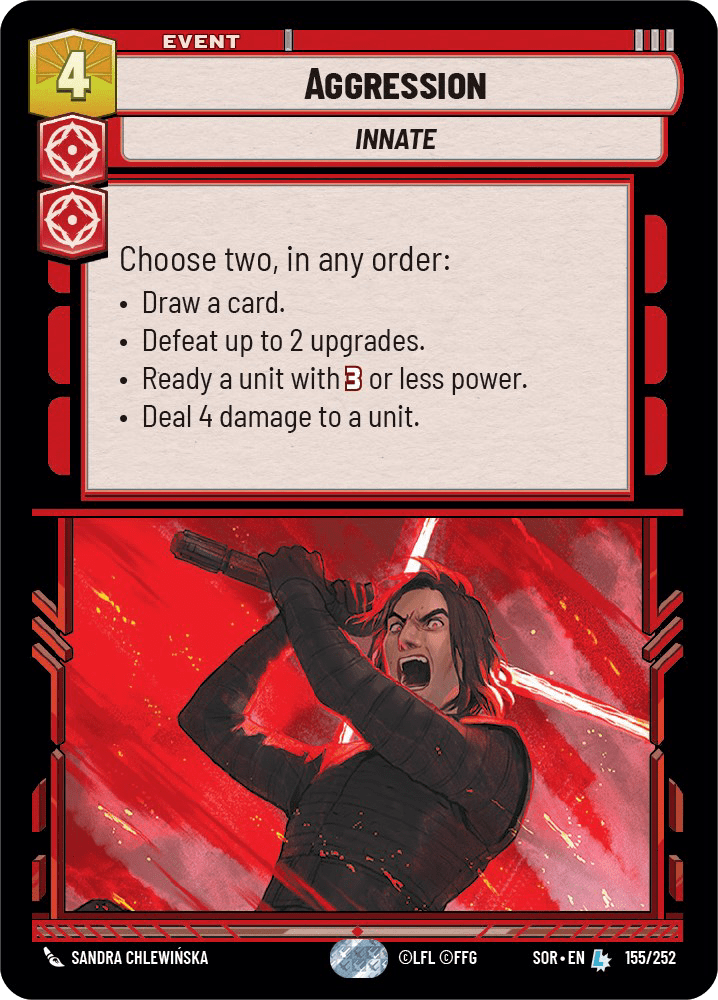
And finally, the last of our legendaries and our final Aspect card, Aggression. Similarly to Command, Aggression offers 4 choices (draw a card, defeat up to 2 upgrades, ready a unit with 3 or less power, and deal 4 damage to a unit) that simply do notstack up to those offered by Cunning and Vigilance. Aggression saw very little play in the set 1 meta, only showing up in some mono Aggression decks, such as mono Aggression Sabine Wren. To rise in these rankings, Aggression needs a mono Aggression deck to rise to relevance. This is perhaps most possible with new leader Kylo Ren, but Kylo Ren’s card ability makes 1 of these options (draw a card) a veritable blank when he is deployed.
This concludes my review on the Spark of Rebellion legendaries and how I think they may stack up in the set 2 meta. Thank you for sticking with me, and I hope you enjoyed the read. Be sure to check back into Space Arena Ground Arena next week for part 2 of my legendaries review when I predict the impact and meta relevance of the spoiled Shadows of the Galaxy legendaries!

 Space Area Ground Arena a Star Wars:Unlimited podcast
Leave a comment