

by Krysis
Greetings, all! Welcome to part 2 of my look at the legendary cards of Star Wars Unlimited. In this article, I will be focusing on the 16 legendary cards soon to be available via the Shadows of the Galaxy expansion. I will, of course, be providing a predictive tier ranking before going on to discuss each card in more detail. If you are new to the SAGA website, or just missed part 1 of my analysis on legendaries (which focused on the Spark of Rebellion legendary cards), I will provide the link to that article below. And for those of you who enjoyed part 1 of this 2 part series, welcome back! Even the redditors who dissected my ranking of the Aggression aspect card. Let me tell you something about that ranking… no, wait, never mind, I promised BananaCrapshoot I wouldn’t bring that up… just kidding, I appreciate you all! If you appreciate the SAGA crew just as much, be sure to subscribe on YouTube, bookmark our website, tell everybody you know! Ok, no more shameless pandering to the masses, promise. Without further ado (besides the link to article 1, of course)…
Legendaries Article Part 1:
S: Poe Dameron (Quick to Improvise), Supreme Leader Snoke (Shadow Ruler), Krayt Dragon
A: The Darksaber, Second Chance
B: Evacuate, Rey (Keeping the Past), Kylo Ren (Killing the Past), Final Showdown, Rule With Respect
C: The Mandalorian (Wherever I Go, He Goes), DJ (Blatant Thief), Kylo’s Tie Silencer (Ruthlessly Efficient), Dryden Vos (Offering No Escape)
D: Finalizer (Might of the First Order), Endless Legions
Now, as I dive into a deeper analysis on each individual card, keep in mind that these tier rankings are relative to one another, comparing only the predictive impact and meta relevance of these 16 cards. This is not reflective of a larger card tier incorporating the entirety of the set 2 card pool. I have play tested, if only in a limited fashion, quite a number of these cards but not enough so that I won’t surely look foolish on a couple of them 2 months from now!
S Tier: Cards within this tier are not only the best of the best legendary cards in the set, but likely to be amongst the best cards in the entire card pool. Cards within this tier shape the meta, if not warp it at times.
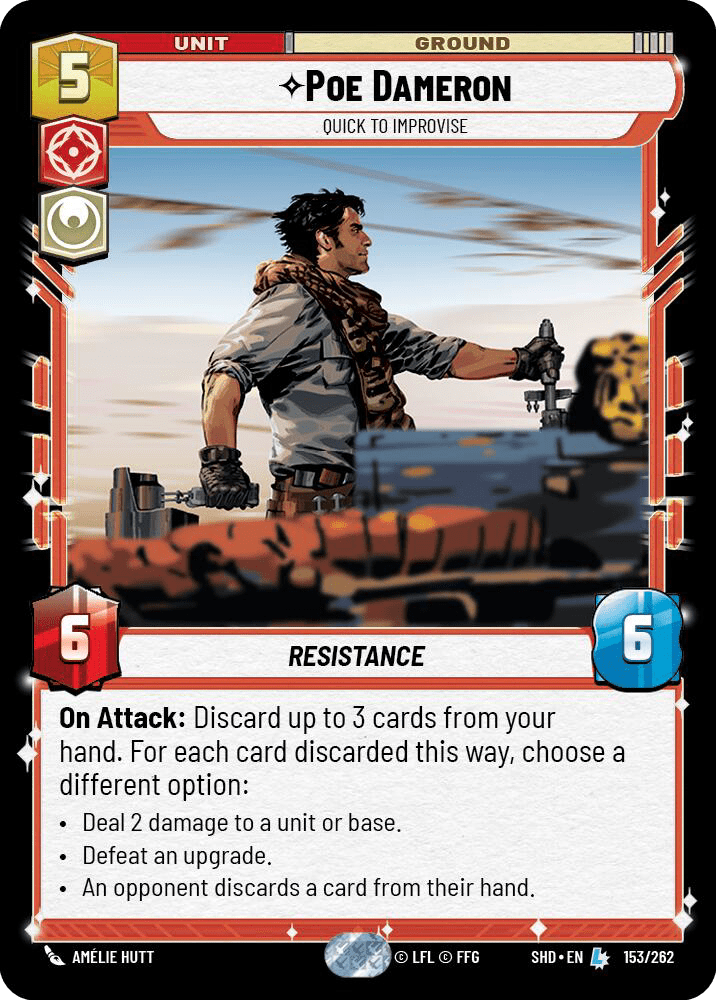
Poe Dameron (Quick to Improvise):
First up in our S-tier list, Poe Dameron. Poe checks in as a 5-cost Aggression Heroism unit, boasting an impressive 6/6 stat line. Simply on the surface, Poe represents a fantastic, high value unit just on the back of his 6/6 stat line alone. Very few 5-cost units boast such a strong stat line. However, Poe also packs quite the On Attack ability. On Attack, Poe allows you to discard up to 3 cards from your hand, choosing a different of the following options for each card discarded: deal 2 damage to a unit or base, defeat an upgrade, an opponent discards a card from their hand. Of course, this ability will have to be deployed wisely and selectively or you will be top decking in no time at all. In reality, I expect more often than not the ability will be used to deal an additional 2 damage. To base, this represents up to an 8 damage swing, or the same to a unit, which happens to be enough to defeat nearly every leader in the game at this point. Because it is On Attack, the 2 damage to unit can also be used to clear a shield before swinging in for 6, which is bad news for leaders such as Iden Versio. I would also expect the “defeat an upgrade” option to be used occasionally, perhaps if the opposing Sabine Wren is wielding a Darksaber or Boba Fett has his armor equipped. I expect Poe to find a home in many Sabine Wren decks, as well as many Han Solo (Worth The Risk) decks.
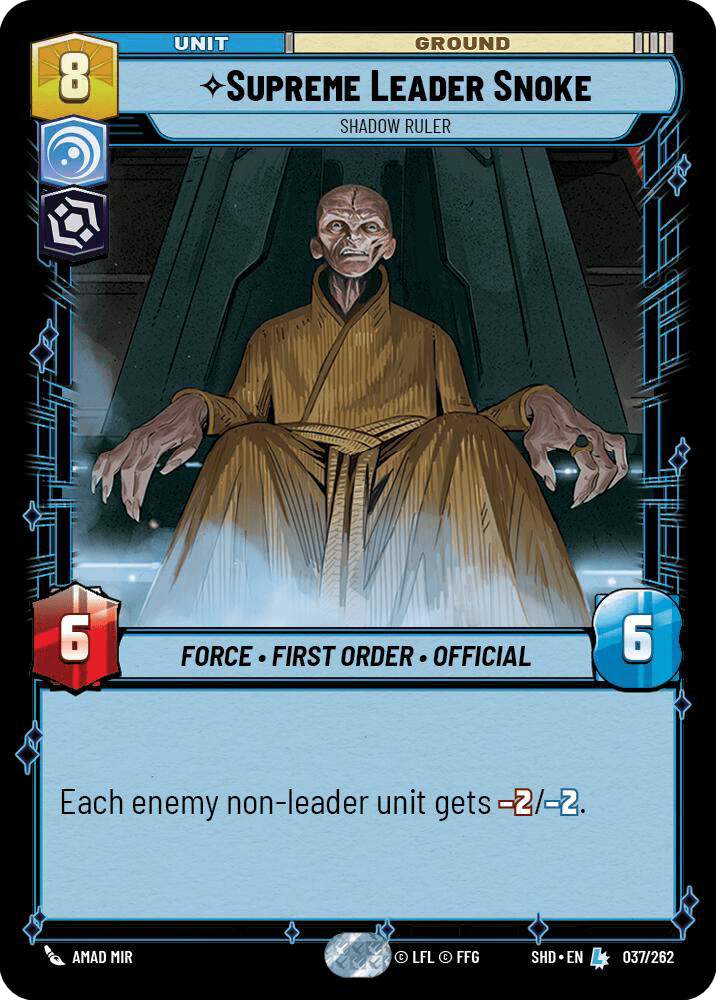
Supreme Leader Snoke (Shadow Ruler):
Next up in our S-tier list, Snoke. Snoke checks in as an 8-cost Vigilance Villainy unit with a stat line of 6/6. Snoke’s 6/6 stat line at 8-cost is not particularly impressive, but his S-tier ranking stems from his static ability that gives each enemy non-leader unit -2/-2. When you consider some of the top meta decks from set 1, such as Command/Cunning Sabine Wren and Command/Cunning Boba Fett, this -2/-2 has the potential to be quite crippling. A deck that can ramp and/or control to get Snoke on board can effectively turn off nearly all the cheap units in these decks, and even outright auto-defeat many common Boba Fett units such as Crafty Smuggler, Seventh Fleet Defender, Greedo, Viper Probe Droid, etc. This turns as much as 20-25% of the deck into dead cards, depending on how many of these cheap units are in the mainboard. Snoke further enables extremely powerful cards like Overwhelming Barrage, given each unit already essentially has 2 damage on it. Surviving vs some of these aggro beatdown decks (while playing ramp/control) was already possible with tight play lines, but these decks will also get new heal engines such as The Client and Top Target, making getting to 8 resources for Snoke even more straightforward than it was in set 1.
Krayt Dragon:
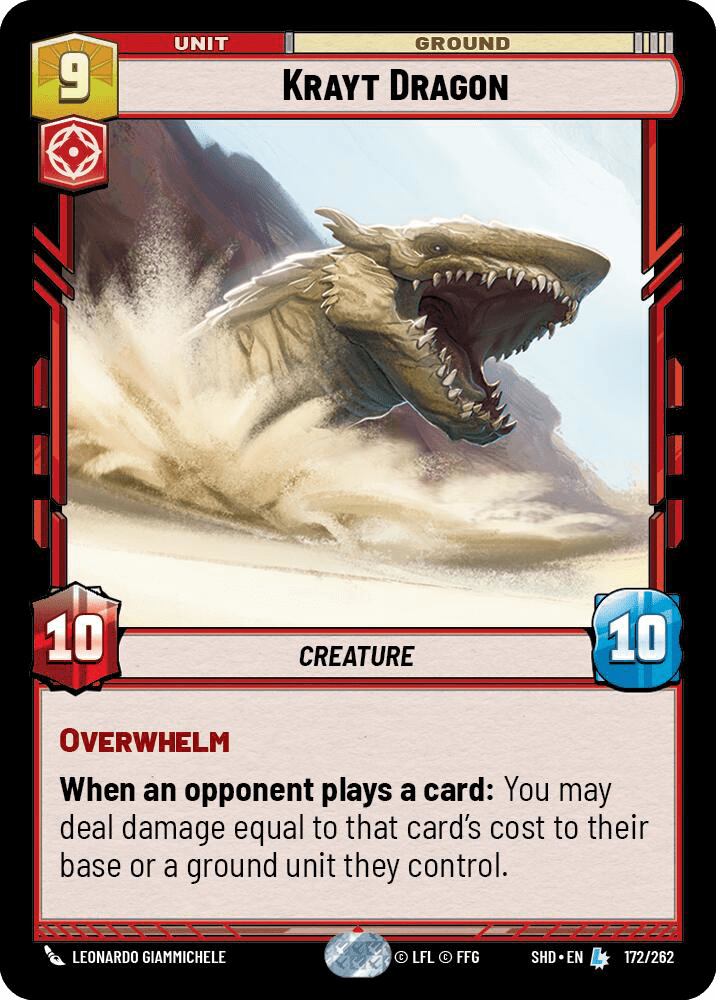
Last in our S-tier, Krayt Dragon. Checking in at a prohibitive 9 resource cost, Krayt Dragon makes up for the cost with an absurd 10/10 stat line with Overwhelm. Krayt Dragon really shines, however, due to its passive ability: “When an opponent plays a card: you may deal damage equal to that card’s cost to their base or a ground unit they control.” While this is likely to most often be used as base damage, it cannot be overlooked just how oppressively it can lock out ground units whose HP is less than or equal to their cost, effectively forcing opponents into the space arena in many cases. Early in the testing process, I felt Krayt Dragon was likely less oppressive than Avenger from set 1 given the lack of When Played impact. However, with additional testing, it became obvious Krayt Dragon is an entire win condition in an even greater capacity than Avenger. Without a clean answer for it (e.g. Vanquish, Fell The Dragon, Rival’s Fall), the game will quickly become out of reach. Expect to see Krayt Dragon as a mainstay in hard control decks, such as Vigilance Darth Vader or Aggression Iden Versio, as well as Aggression ramp decks such as Command Darth Vader and Command Han Solo (Worth The Risk).
A Tier: Cards within this tier are highly impactful and/or fit into many deck archetypes. They may not dictate or warp the meta as a whole, but are often found in some of the best decks in the format.
The Darksaber:
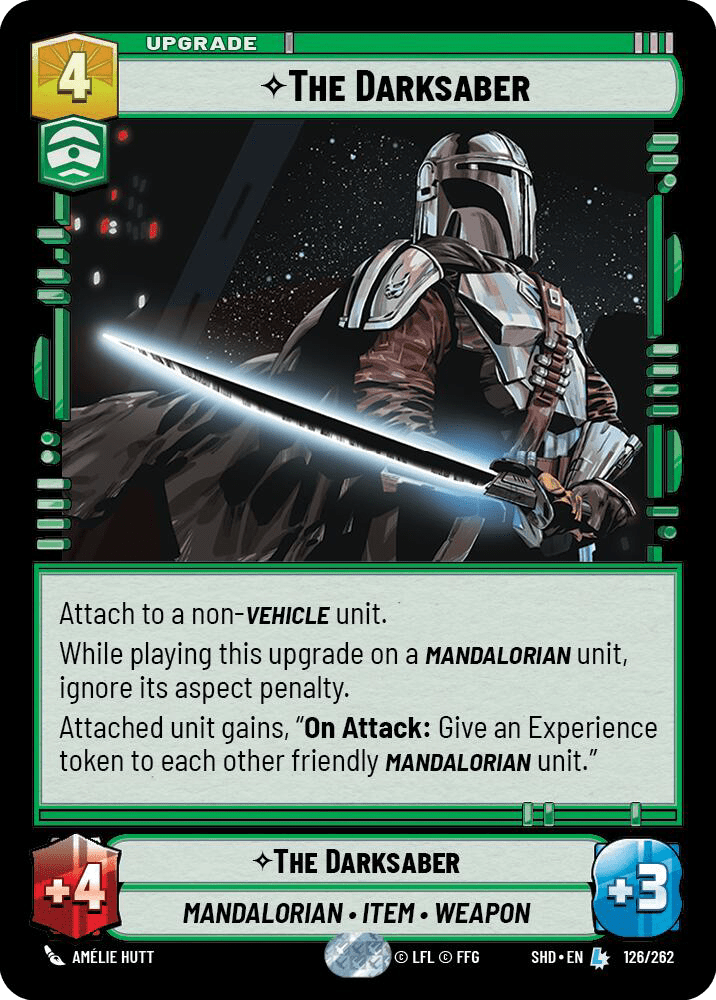
First on our list of A-tier legendary cards, The Darksaber. The Darksaber checks in as a 4-cost upgrade, granting the equipped unit +4/+3. Furthermore, if equipping to a Mandalorian tribal unit, you may ignore the aspect penalty otherwise associated with playing the card out of aspect. And as further Mandalorian tribal synergy, the attached unit gains “On Attack: Give an experience token to each other friendly Mandalorian unit.” Clearly designed to augment Mandalorian tribal synergy, this is exactly what Sabine Wren decks did NOT need! Assuming Sabine Wren remains highly popular in the competitive meta (which she will), you will need to be prepared to have an answer for this upgrade on her, especially as it happily coincides with her deploy cost. However, it also represents a hearty boost to the Sabine Wren unit, as well as new Mandalorian units such as Ketsu Onyo. Looking to the villainy side, this is a perfect upgrade for new leader Gar Saxon, given you get to ignore the aspect penalty for Mandalorian wielders, and he even treats it as a +5/+3 given his passive leader ability. Wise players will be prepared with upgrade hate right out of the set 2 gate, in preparation for this card.
Second Chance:
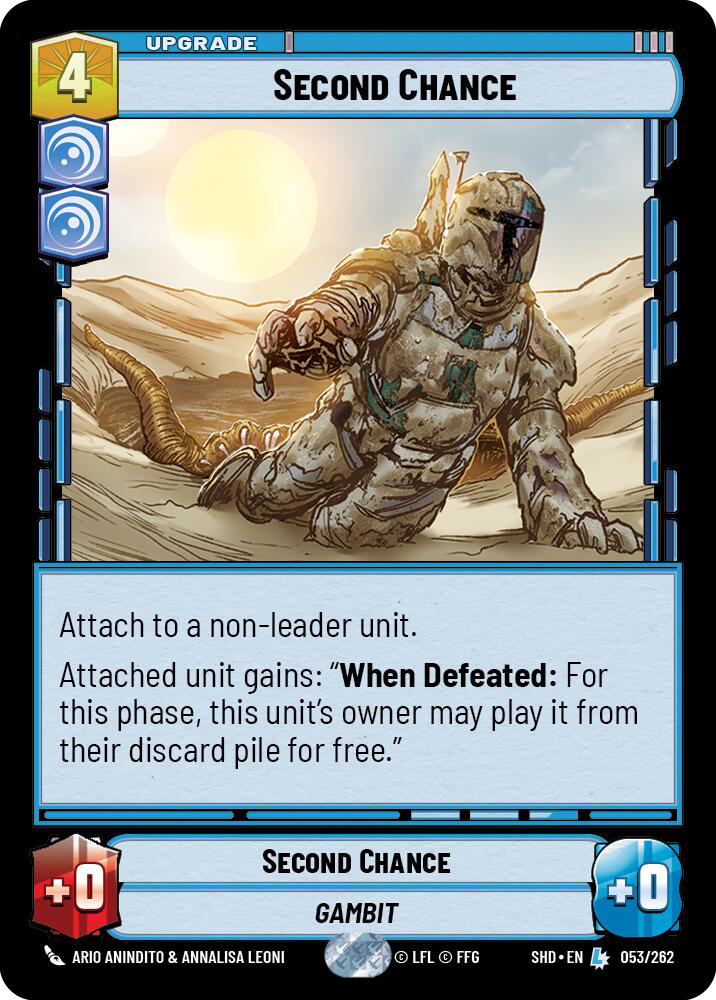
Last on our A-tier list, Second Chance. Second chance is a double Vigilance aspect upgrade that grants the attached unit a When Defeated effect of “For this phase, this unit’s owner may play it from their discard pile for free.” My A-tier ranking on this card is somewhat speculative, as I have not had the opportunity to really play test it yet. However, it is the kind of card ability that I expect somebody to truly unlock sooner or later. Up front, I would expect to see this used on some beefy sentinel units, such as Lieutenant Childsen or Bendu, potentially in the framework of a mono Vigilance Iden Versio control/mill deck. Second Chance also has some fun synergies with units that have When Played abilities, such as Luke Skywalker, allowing him to trade into a large opposing unit and redeploy from discard to likely wipe another opposing unit due to Luke’s -6/-6 When Played effect after a unit (himself, in this case) has been defeated that round.
B Tier: Cards in this tier have exceptionally strong use cases and abilities, but generally do not have as significant an impact on the meta as S-tier or A-tier cards. They will see heavy play, though as the meta shifts may become more common in sideboards than mainboards.
Evacuate:
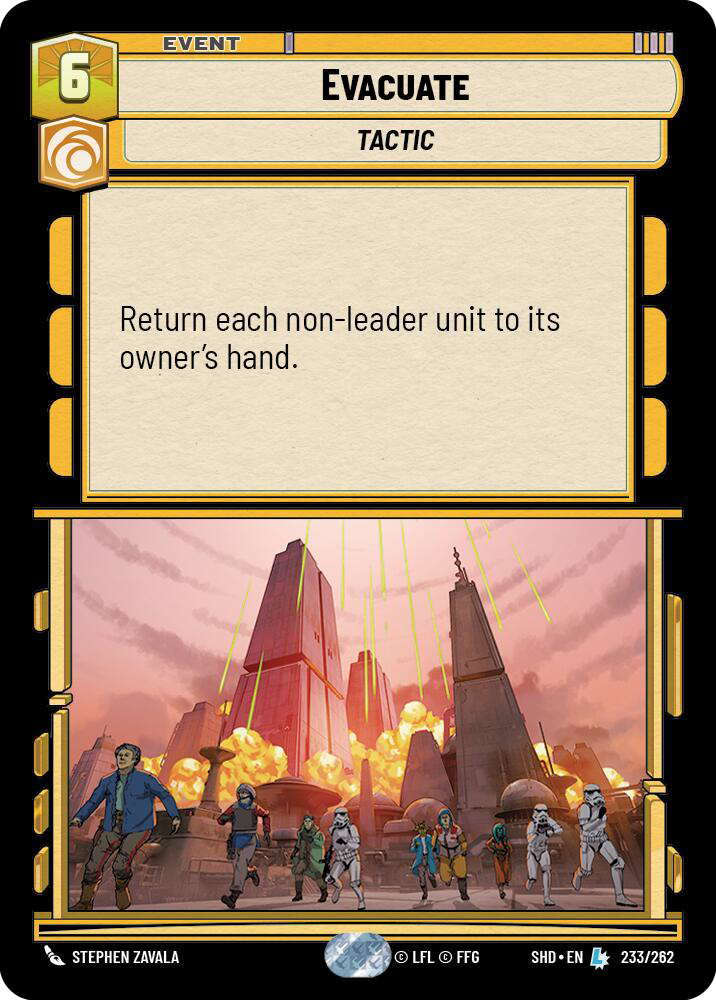
First up among our B-tier legendaries is Evacuate. Evacuate is a 6-cost Cunning event card that returns all non-leader units to its owner’s hand. Similar to Superlaser Blast from set 1, this card is likely to become a staple in very specific types of control oriented decks. While somewhat offset by the lower resource cost, I believe Evacuate will generally be an inferior option to Superlaser Blast, however, due to the fact that it is returning units to hand instead of outright defeating them. Timing and sequencing will be paramount with this card, insuring you get maximum value from your deployed units as opposed to simply casting it first action, in most cases. However, there is likely to be control decks happy to cast it first action to simply stall out an entire round in route to Superlaser Blast or other large, high impact units. Evacuate could also have some potential additional synergy with Boba Fett, perhaps in a Vigilance Boba Fett build, given it will grant him the ability to untap resources due to opposing units leaving play. Also be on the lookout for Vigilance Thrawn decks that will have access to this, as well as Superlaser Blast, and a host of other exhaust/remove event options.
Rey (Keeping the Past):
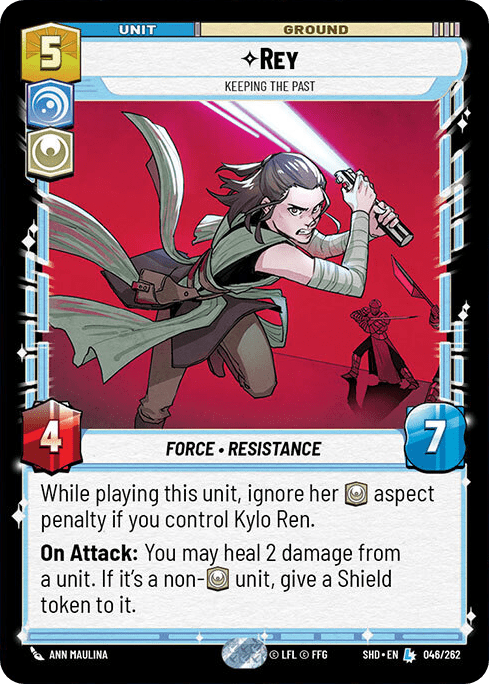
Next up on our B-tier list, the hero of the new generation of Star Wars fans, Rey. Rey checks in as a 5-cost Vigilance heroism unit with a respectable 4/7 stat line. Furthermore, Rey can be played without paying the heroism aspect penalty (in villainy decks) if you control Kylo Ren. What lovely synergy! Rey also sports an On Attack ability that allows you to heal 2 damage from a unit, and if it is a non-heroism unit, you give it a shield token. Rey’s 4 power is somewhat underwhelming for a 5-cost unit, but the 7HP gives her staying power and I anticipate her ability will be relevant in certain deck builds. The ability to heal 2 from a unit and shield it (if a non-heroism unit) is highly relevant when discussing large sentinel units, such as Bendu, or even a unit such as Fenn Rau, who was likely just upgraded into a unit of game-winning potential, given her When Played ability. I anticipate the Kylo Ren synergy to be less relevant, however, as early testing seems to indicate Cunning will be the best aspect pairing for the Kylo Ren leader, and trying to match up the Rey and Kylo units on board together will likely prove to be too combo-y to be consistent.
Kylo Ren (Killing the Past):
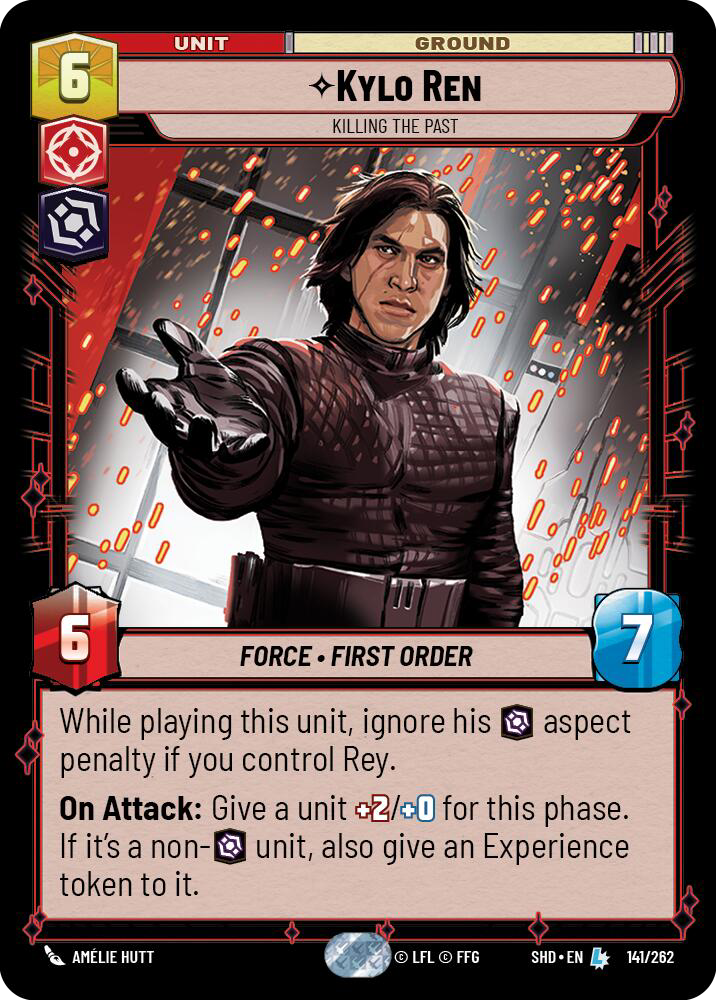
Next up in B-tier is the son of Han Solo and Leia Organa, Kylo Ren (aka Ben Solo). Kylo checks in as a 6-cost Aggression villainy unit and boasts a strong 6/7 stat line. LikeRey, you may ignore his villainy aspect penalty (in heroism decks) if you control Rey. Kylo also packs an On Attack ability that grants a unit +2/+0 for that phase, and if it is a non-villainy unit, it gives them an experience token. I think the most important takeaway from this On Attack ability is the wording of “a unit”, instead of “another unit”, meaning Kylo is able to buff himself into an 8/7 hammer of dark side wrath. This reality makes him a threat to nearly every leader unit currently in the game, especially when coming out of left field via the ambush effect from cards such as Energy Conversion Lab or Timely Intervention. As such, I would expect to see Kylo played often in Aggression Villainy decks that are utilizing the Energy Conversion Lab base and/or Timely Intervention, such as Command Darth Vader.
Final Showdown:
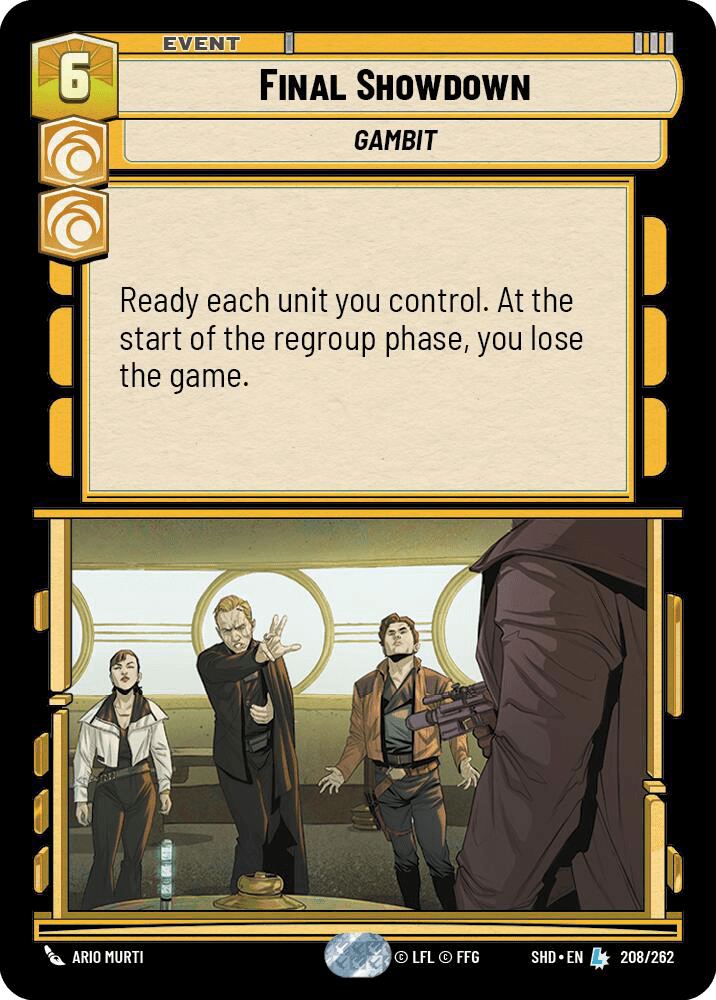
Up next in our B-tier is the 6-cost, double Cunning aspect event, Final Showdown. Final Showdown allows you to ready each unit you control, but you lose the game at the start of the regroup phase. Final Showdown cracked my B-tier primarily on the back of 1 deck I expect to see it in, mono Cunning Boba Fett. As somebody who played a fair bit of Cunning Boba Fett in set 1, I can say that most lost games came down to being just an action or two behind or simply running out of gas a few damage short vs control or some mid-range decks. This card solves both problems as another potential back breaking 6-drop, along with Fett’s Firespray. In reality, however, this card is likely to be an include, at least in the sideboard, for any mono Cunning tempo/on-curve aggro decks, whether that be via Cad Bane, Fennec Shand, or the aforementioned Boba Fett. Of course it should go without saying, but do not play this card if you are not certain you are going to win the game off of it! Be sure to sequence correctly and, ideally, play it when the opponent has exhausted all or most of their units and is tapped out on resources!
Rule With Respect:
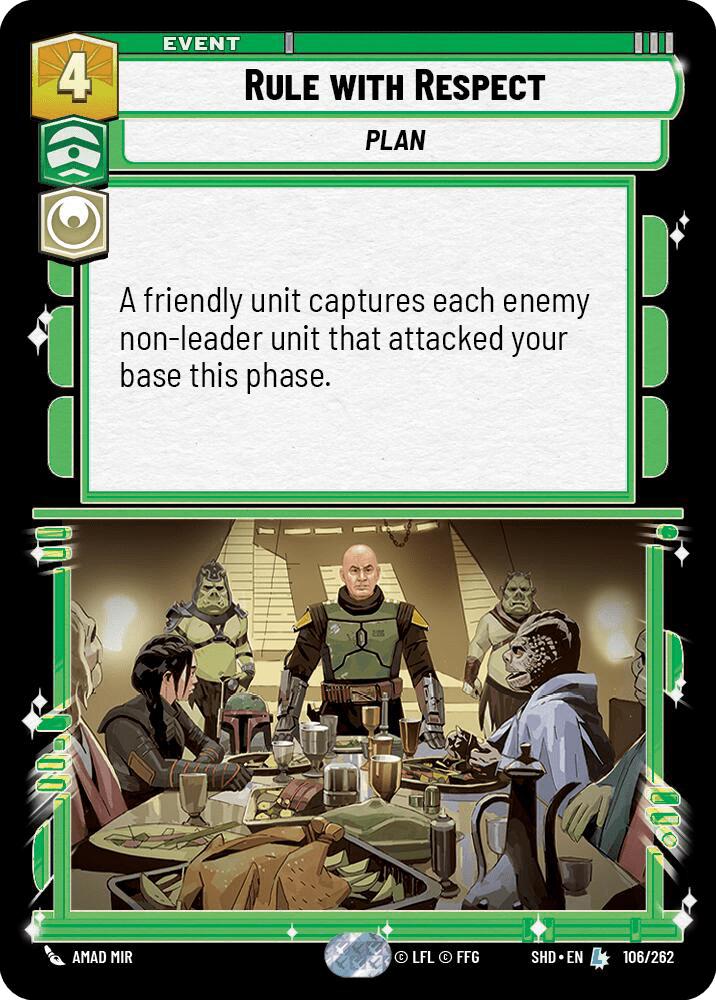
Last in our B-tier group is the 4-cost Command Heroism event, Rule With Respect. Rule With Respect allows you to capture each enemy non-leader unit that attacked your base this phase. Rule With Respect was a difficult card to rank despite fairly extensive testing with it prior to this article. I have found that the card seems to most often be either a complete blowout (often vs aggro decks) or largely dead. It also has the oftentimes awkward requirement of allowing the opponent’s units to attack your base unhindered. And, in general, I have been somewhat underwhelmed by the capture mechanic introduced in set 2. With that said, Rule With Respect represents the potential for a complete blowout scenario in decks with hearty and/or shielded units and the ability to Restore, such as Command Rey and Command Luke Skywalker, allowing it to check into our B-tier.
C Tier: Cards in this tier remain powerful, but typically have something prohibitive or limiting about them that make them difficult to use effectively on a consistent game in, game out basis.
The Mandalorian (Wherever I Go, He Goes):
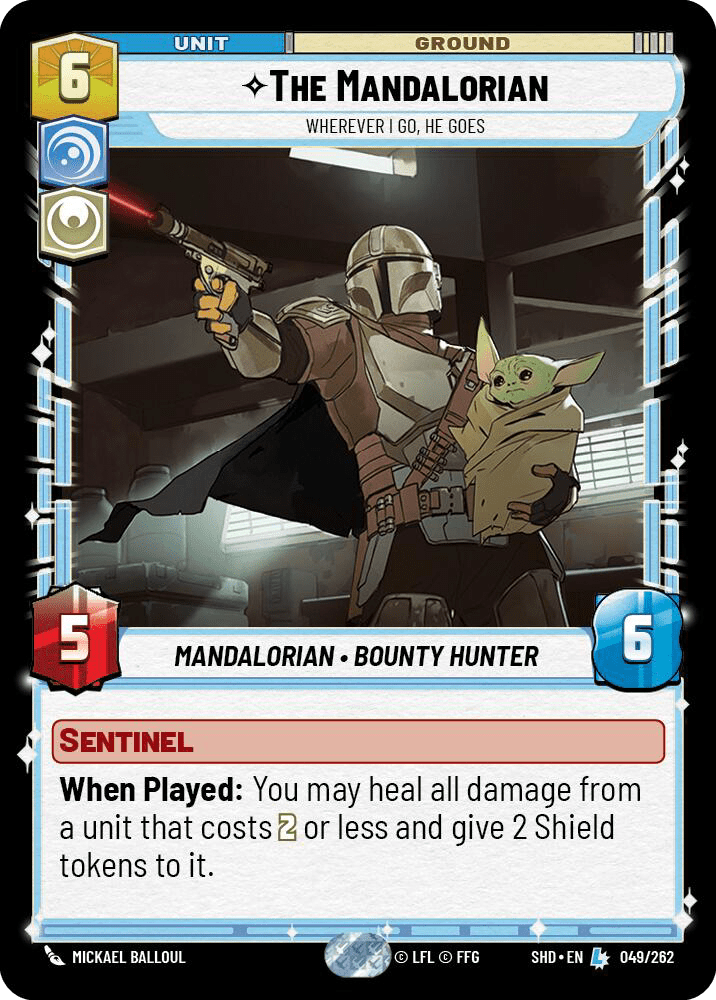
First up in our list of C-tier legendaries is everybody’sfavorite Disney Plus protagonist, The Mandalorian. Mando checks in as a 6-cost Vigilance Heroism unit, sporting a 5/6 stat line with the Sentinel keyword. Mando also boasts a When Played ability that allows you to heal all damage from a unit that costs 2 or less and give it 2 shield tokens. Clearly designed to synergize with Grogu, Mando will likely see his greatest benefit, however, with other 2-cost units that are heavily pumped up. Imagine a Follower of the Way upgraded with The Darksaber, now with a 6/7 stat line, just to see Mando enter play as a 6HP sentinel that restores Follower to full HP with 2 shields, making him essentially indestructible to anything except hard removal events. Ultimately, however, Mando resides in my C-tier due to other non-legendary, similarly costed/statted Sentinel units such as Obi-Wan Kenobi and General Rieekan (aka Rieekan the Destroyer… seriously though, how does this guy have the same stat line as Darth Vader???) existing and with the Mando ability being limited in scope to 2-cost or less units.
DJ (Blatant Thief):
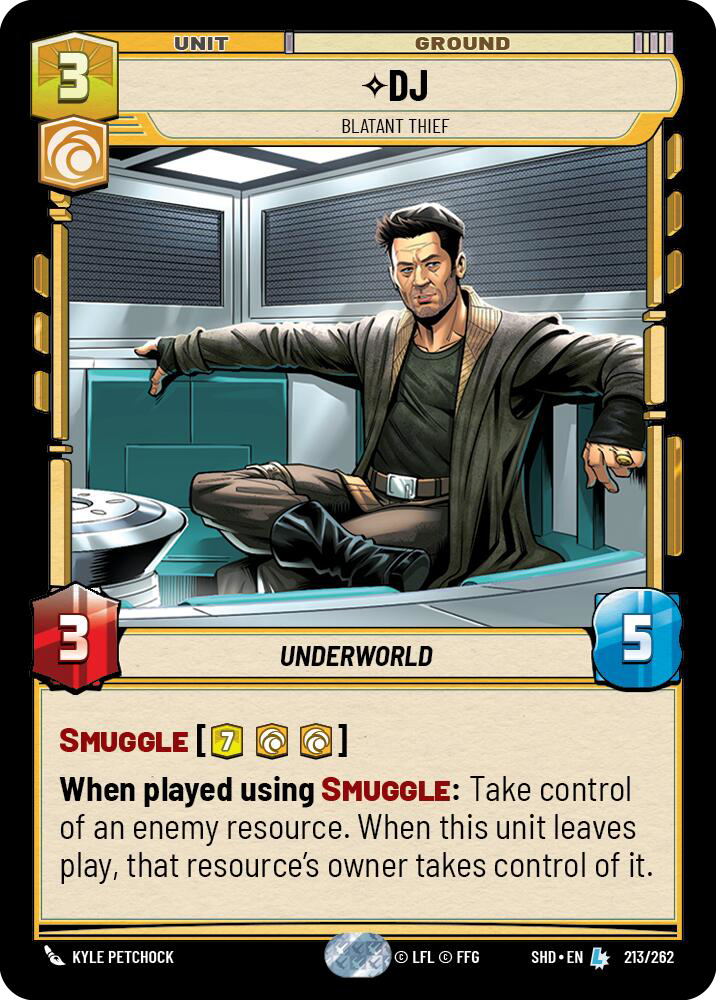
Next up in our C-tier list, master of the 5-finger resource discount, DJ. DJ checks in as a 3-cost Cunning unit with a 3/5 stat line. DJ also has a Smuggle (or as well call it at SAGA after a fateful auto-correct, Snuggle) cost of 7 to gain the When Played ability to take control of an enemy resource and place it under your control (however, when DJ is defeated, it returns to enemy control). What a guy, Snuggle and then steal from you. For starters, DJ is a high value 3-cost unit given the 3/5 stat line that once upon a time was headlined by only Boba Fett (but is now sported by several new 3-cost units, including DJ, Toro Calican, and Cassian Andor). The Snuggle ability has some obvious applications, most notably delaying a leader deploy for leaders such as Darth Vader or Emperor Palpatine, or delaying a potential Superlaser Blast. This in and of itself can be highly impactful. I have placed DJ in my C-tier, however, given the prohibitive cost of the Snuggle ability at 7 resources. I suspect there will be far too many cases where you burn all 7 resources to steal 1 and delay a deploy, just to see the opponent follow up with a basic removal event like Takedown or Force Choke. With that said, DJ is one to keep an eye on, and one I acknowledge I could end up being much too low on.
Kylo’s Tie Silencer (Ruthlessly Efficient):
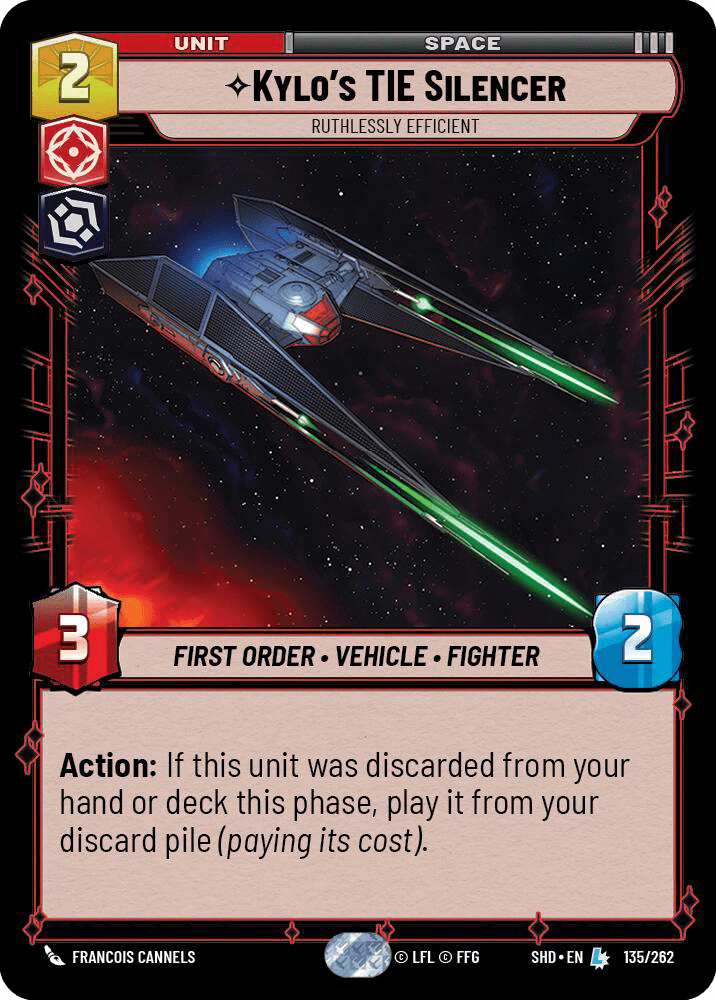
Up next in C-tier is Kylo’s Tie Silencer (wait, didn’t Rey like cut this thing in half or something?). Checking in as a 2-cost space unit with a 3/2 stat line, Kylo’s Tie Silencer immediately represents value to villainy decks in the form of a sparsely seen 3/2 statted 2-cost space unit. I anticipate Kylo’s Tie will see play on those grounds alone. However, Kylo’s Tie also includes an ability that allows you to play it from your discard pile (paying its cost) if it was discarded from your hand or deck this phase. This ability represents a bit of control/mill hate, but more so synergizes with the ability of the new Kylo Ren leader, who allows you to discard a card from your hand in exchange for giving a unit +2/+0 for the phase. While in some respect this is a bit of a non-bo with the Kylo leader, in testing I have found it pretty simple to gut your hand playing Kylo in order to maximize his deploy ability, making his Tie especially valuable post-deploy when you’re wanting the +2/+0 pump to push the last damage out but need the play another unit down, as well. Overall, however, I suspect Kylo’s Tie will be of marginal impact on most games/in most decks.
Dryden Vos (Offering No Escape):
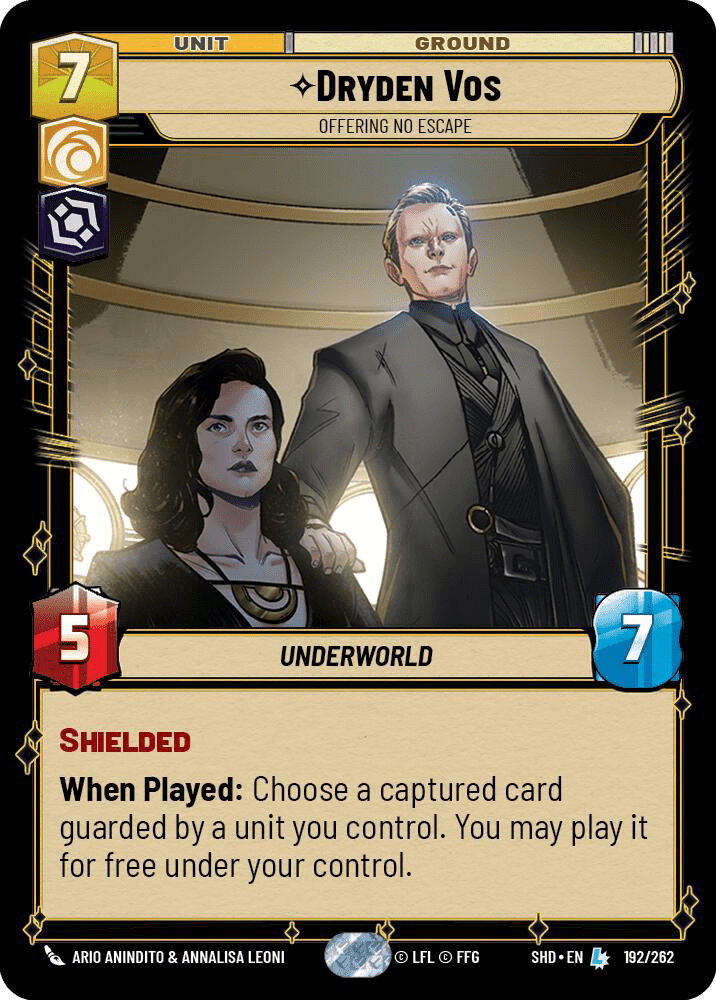
Last in our C-tier is the 7-cost Cunning Villainy unit, Dryden Vos. Dryden boasts a strong 5/7 stat line, which is further improved by him entering play Shielded. Dryden also packs a potentially potent When Played ability that allows you to choose a captured card guarded by a unit you control, and play it for free under your control. In a vacuum, Dryden is representative of a reasonably strong late game unit. However, Dryden resides in my C-tier for several reasons. First, he is generally outclassed by other 7-drop villainy units, including Darth Vader and Maul, and arguably even Fennec Shand within the Cunning aspect, depending on your deck build. Furthermore, as I previously alluded to, I am somewhat underwhelmed by the capture mechanic in general. With that said, there are certainly some brutal combos that exist with Dryden, such as making use of the Take Captive or Relentless Pursuit events the round prior to a Dryden deployment. As with all combo plays, however, this will often be inconsistent game to game, but will certainly result in some stolen wins along the way.
D Tier: Cards in this tier are objectively weaker than other legendaries, and have fewer prospects or scenarios in which they could move up the ranking. They are not unplayable in the full card pool, but can be out classed by common/uncommon cards in specific build styles.
Finalizer (Might of the First Order):
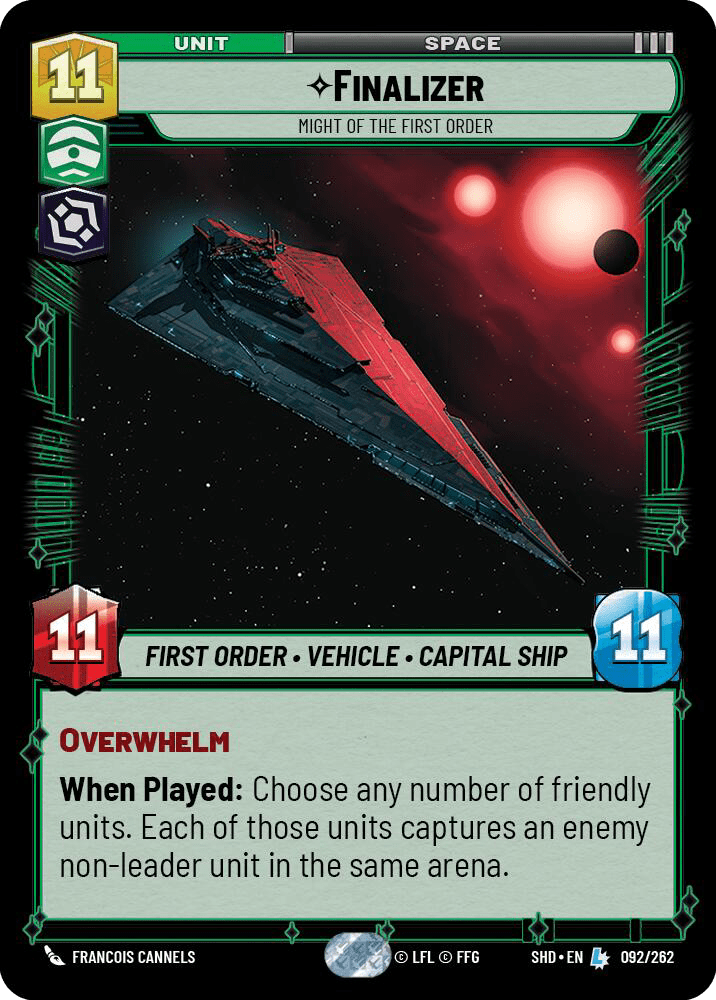
First up in our D-tier of legendaries is Finalizer, Might of the First Order. Finalizer checks in as a behemoth 11-cost Command Villainy space unit that boasts an outrageous 11/11 stat line. Finalizer also sports a When Played ability that allows you to choose any number of friendly units and have them each capture an enemy non-leader unit in their same arena. So, Finalizer not only has a gargantuan 11/11 stat line, but also represents a veritable board wipe if you have additional boarded units. Nonetheless, Finalizer checks into my D-tier, first and foremost for being so cost prohibitive. However, beyond the cost, the unit and its ability seem likely to be outclassed (especially at a cheaper resource cost) by other large space units such as Avenger and Devastator. With that said, this will be one to keep an eye on in the future should a deck emerge that can efficiently utilize a card like Galactic Ambition, or that can rapidly ramp up in resources.
Endless Legions:
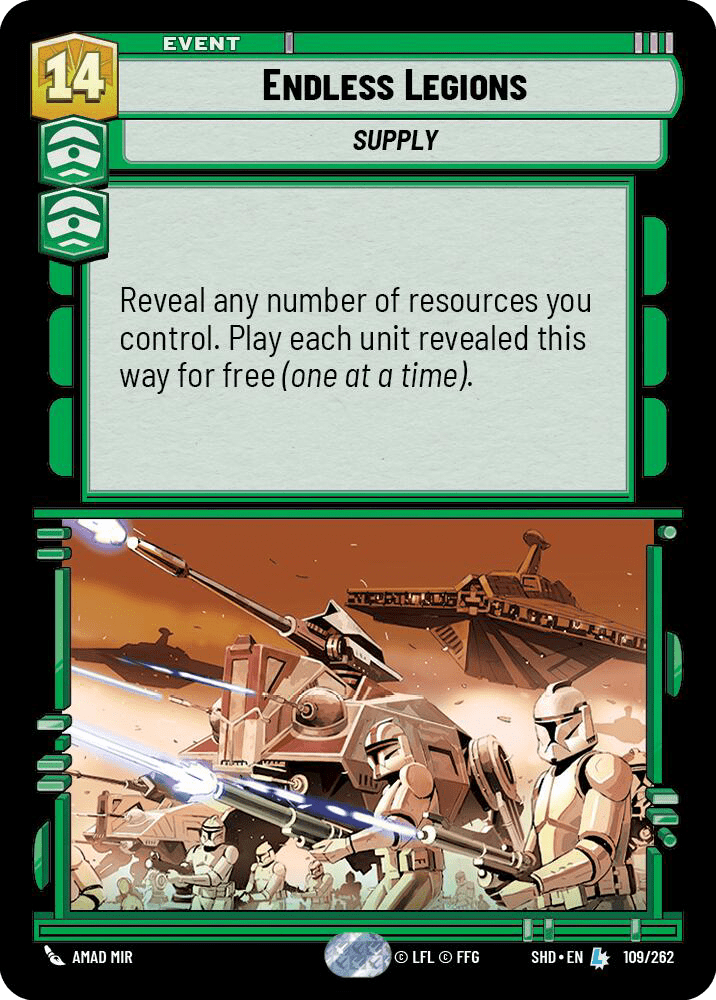
Speaking of needing a deck that can rapidly ramp resources…. Our final card in D-tier, Endless Legions. Endless Legions checks in with a comical 14 resource cost, in the double Command aspect, no less. In exchange for 14 resources, Endless Legions allows you to reveal any number of resources you control and play each unit you revealed this way, for free. To be clear, should you pull this off, you will win the game. With that said, the 14 resource cost is so wildly prohibitive that in the current state of the game, it is exceedingly difficult to envision a deck that simultaneously ramps and controls effectively enough to reach 14 resources in a timely manner and not be within an action of defeat. As more and more ramp options become available (e.g. Price on Your Head) and more and more heal/Restore options become available, this card may become a more viable win condition. Until that time, I expect this one will largely remain in the binder.
This concludes my predictive tier ranking and analysis on the 16 new legendaries coming with the Shadows of the Galaxy expansion. Thank you for the time you’ve taken to read this article, and be on the lookout for my future articles and all other SAGA content!

 Space Area Ground Arena a Star Wars:Unlimited podcast
Leave a comment